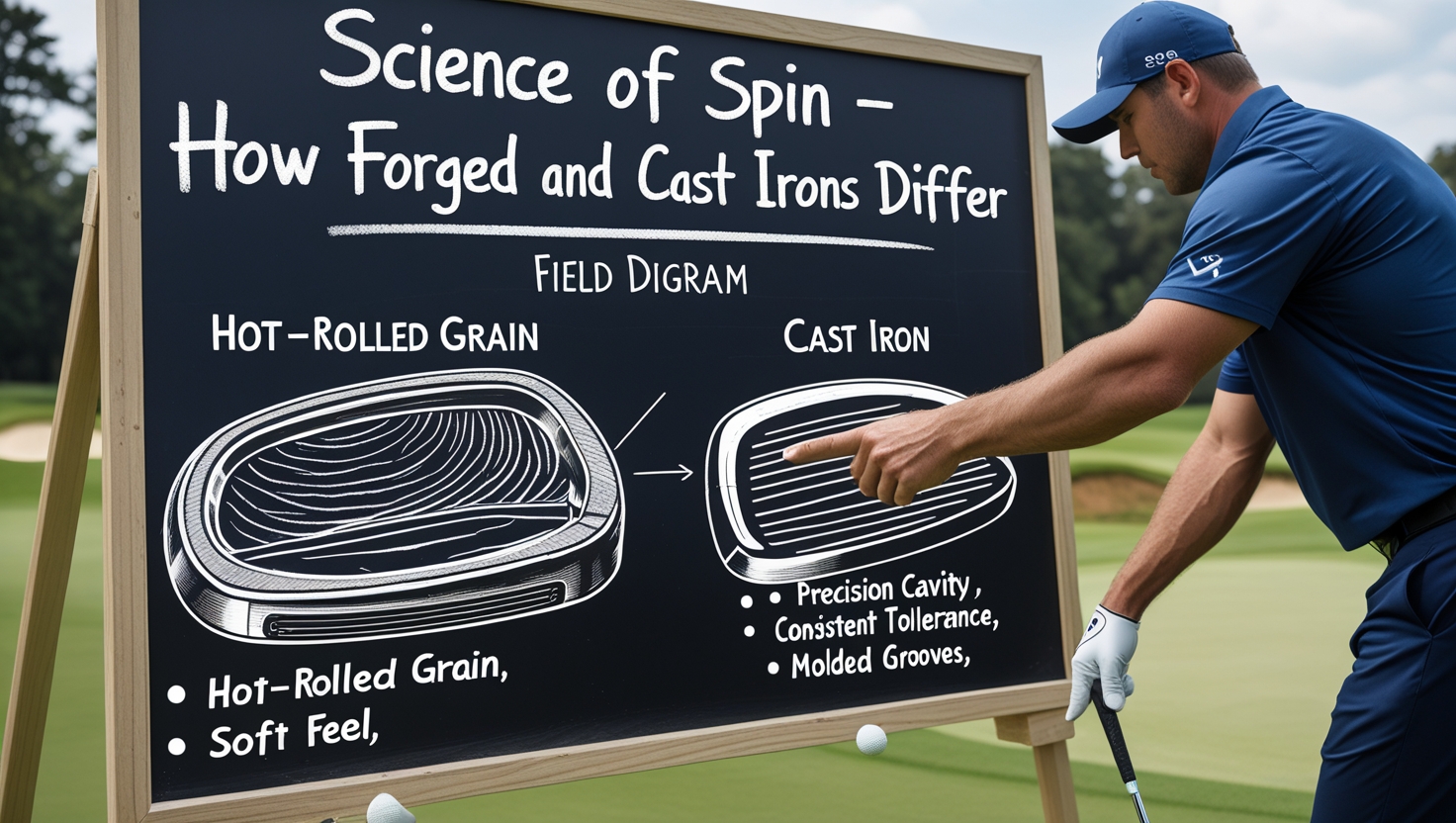
Imagine stepping onto the course with clubs that not only feel custom-tailored for your swing but also harness the subtle art of spin to shape every shot. In today’s competitive arena, understanding the science of spin in golf isn’t just for professionals, it’s a game-changer for every enthusiast. The way a club interacts with the ball is dictated by its very essence: whether it is a meticulously hand-crafted forged iron or a precision-engineered cast iron. This article digs into the innovative techniques behind these irons, revealing how their manufacturing molds the art of spin and performance. Whether you’re fine-tuning your grip for better accuracy or seeking the perfect blend of feel and durability, read on to discover how these two types of irons can revolutionize your game.
The Heritage and Craft of Forged Irons:
Forged irons are steeped in history and tradition. Born from a process that involves heating a solid billet and then hammering it into shape, these clubs are renowned for their superior feel and responsiveness. Unlike mass-produced alternatives, forged irons benefit from the skilled craftsmanship and attention to detail that only traditional metalworking can deliver. The forging process minimizes internal metal inconsistencies, creating a dense, balanced clubhead that responds dynamically with every swing.
This hands-on approach lends forged irons a distinct personality, one that many low-handicap players and purists covet. Their refined design allows for precise shaping of the clubface, which in turn impacts the science of spin by offering enhanced feedback and control on impact. When you strike the ball with a forged iron, the club’s malleable structure helps distribute the force evenly, resulting in a shot that feels smooth, controlled, and communicative of the golfer’s intent. In essence, each forged iron carries a blend of art and science, where tradition meets modern athletic precision, making it a favored choice for those who demand finesse on the course.
The Precision Behind Cast Irons:
In contrast, cast irons are a product of modern manufacturing ingenuity. Produced by pouring molten metal into finely crafted molds, these irons boast a design flexibility that allows manufacturers to integrate innovative performance-enhancing features. The casting process is far less labor-intensive and offers higher repeatability, ensuring that each club maintains a consistent quality and performance level.
Cast irons often feature complex internal geometries that help lower the club’s center of gravity, promoting higher launch and greater distance. The design also lends itself to improved durability; the casting process creates a robust structure that can withstand the repeated impacts of intense play. For many golfers, especially those who require forgiveness and consistency over raw precision, cast irons offer a more accessible entry point into high-level performance. Their ability to incorporate perimeter weighting and cavity-back designs enhances both spin regulation and ball trajectory, making them a favorite among mid- to high-handicap players. The modern twist on traditional golf club manufacturing ensures that cast irons deliver dynamic playability while remaining robust and reliable.
How Construction Influences Your Swing:
The very essence of the science of spin is determined by how the clubface interacts with the ball at the moment of impact. Both forged and cast irons have distinct characteristics that influence spin, trajectory, and overall shot performance. When a golfer swings, the dynamic properties of the club, its density, balance, and surface consistency, play a direct role in instilling spin on the ball.
With forged irons, the localized precision in the clubface allows for fine-tuned spin control. The intimate feel enables players to delicately adjust their impact point, resulting in a balanced combination of draw or fade based on the shot design. Conversely, cast irons, with their often broader and more robust face designs, can generate a more consistent launch angle. This consistency is key for golfers who value repeatability over nuanced feedback. In both cases, the engineering behind the club, the weight distribution, the design of the clubface grooves, and the overall balance, work in tandem to deliver measurable spin rates that can significantly alter ball flight and stopping power on the greens.
Enhancing Performance Through Metallurgy:
Delving deeper into the science of spin, it’s clear that material properties profoundly influence club performance. The forging process allows for a homogenous metal structure, which minimizes internal defects and offers unparalleled sensitivity at the moment of impact. A club forged from a premium billet responds swiftly to subtle variations in swing speed and angle, translating into spins that are both controlled and expressive.
On the other hand, the benefits of casting include the ability to experiment with different metal alloys and composite materials. Manufacturers can blend elements to create a harder, more resilient clubhead that excels under prolonged play. These enhancements not only improve the durability but also refine the spin control by ensuring that energy transfer occurs in a controlled manner. The precise engineering involved in both processes emphasizes tailored spin dynamics: forged irons offer a delicate balance of feedback and power, while cast irons deliver consistent performance with a slightly increased tolerance for off-centered strikes. By leveraging material mastery, experts can push the boundaries of what is possible in golf club technology, ensuring that each subtype of iron offers a unique advantage tailored to specific playing styles.
Customization in Iron Design:
One of the most exciting advancements in modern golf club manufacturing is the move toward personalization. Today’s golfers can choose clubs that are not only designed for their playing style but also optimized for their specific swing dynamics. Whether opting for forged irons or cast irons, customization options now extend far beyond mere aesthetic choices; they delve into the very heart of performance.
Customization can include adjustments to loft, lie, shaft flex, and even weight distribution. For instance, a player seeking more spin control might prefer the soft feedback of forged irons, while another who prioritizes distance and a higher launch angle might lean toward the engineered precision of cast irons. Modern fitting techniques use high-speed cameras, dynamic swing analysis, and simulation software to recommend the ideal configuration. This individualized approach ensures that each club is a bespoke extension of the player’s physical attributes and preferences. As a result, golfers are not left to suit off-the-rack solutions; instead, they have the opportunity to optimize the intricate balance between feel, power, and spin, making every swing a uniquely tailored performance.
Merging Tradition with Technology:
As technology continues to evolve, so does the future of golf club design. The integration of AI-driven analytics, advanced simulation software, and state-of-the-art manufacturing techniques is blending the traditional methods of forging with modern casting innovations. This fusion is yielding clubs that not only preserve the best features of each manufacturing process but also push the boundaries of performance beyond conventional limits.
For example, machine learning algorithms now help predict how various design tweaks will influence spin rates, ball trajectory, and feedback. This data-driven approach allows manufacturers to experiment with hybrid models that combine the soft touch of forged irons with the durability and forgiveness of cast irons. These innovations are particularly evident in the evolution of clubface design, where minute changes in the groove geometry can result in significant advances in control and power. Embracing these technological innovations means that clubs are no longer static instruments, they’re evolving performance tools tuned to maximize both the art and science of spin. Golfers who adopt these next-generation clubs are likely to see immediate improvements in consistency, accuracy, and overall playability.
Conclusion:
In just a few strokes, you can transform your game by choosing the right blend between tradition and technology. Forged irons offer exquisite feel and responsive spin control, while cast irons deliver modern durability and consistent performance. Embrace the science behind the spin to elevate every shot.
FAQs:
1. What distinguishes forged iron from cast iron?
Forged irons are hand-shaped for superior feel, while cast irons are molded for consistency.
2. How does the manufacturing process affect spin?
Forged irons allow for delicate spin control; cast irons promote consistent launch and spin.
3. Which type is better for precision play?
Players seeking nuanced feedback often prefer forged irons.
4. Are cast irons more durable?
Yes, the casting process creates robust clubs that are highly durable.
5. Can I customize my irons?
Absolutely—both forged and cast irons offer extensive customization options.
6. Which should I choose for my game?
That depends on your style: choose forged for feel and cast for forgiveness.